
認識白蝕
Vitiligo:Clinical features and Diagnosis
The typical patch: Well-demarcated, chalky or milky white, round to oval, with a normal surface texture — not scaly, not raised, not itchy. Some patients report mild itch before a new patch appears. Patches enlarge outward over time.
Common sites: Around the eyes and mouth; the backs of the hands, fingers and wrists; elbows and knees; ankles and feet; armpits, groin and genitals; and areas of repeated friction.
Associated findings
Leukotrichia (white hairs within a patch) - indicates the follicular reservoir is depleted. This predicts poorer repigmentation, and is important to identify before starting treatment so expectations are set correctly.
Halo naevi - a mole with a white ring around it, more common in vitiligo.
Premature greying of hair.
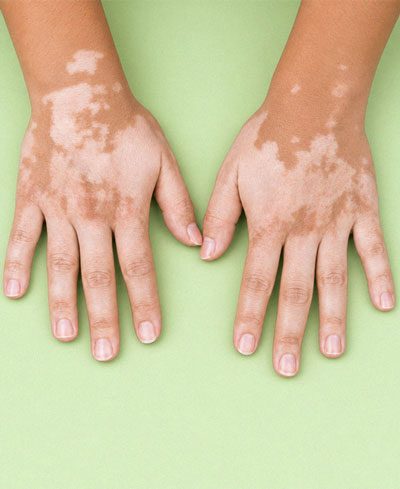
Associated medical conditions. Vitiligo travels with other autoimmune disease. Autoimmune thyroid disease is by far the most common, seen in roughly 15–20% of patients. Also associated: type 1 diabetes, pernicious anaemia, alopecia areata, Addison's disease and rheumatoid arthritis. Baseline thyroid function and thyroid antibody testing is reasonable in most patients, with further testing guided by symptoms. Screening is worthwhile because thyroid disease is common, treatable, and frequently silent in its early stages.
Psychological impact. This is not a soft endpoint. Studies consistently show rates of depression, anxiety, social avoidance and impaired quality of life comparable to or exceeding those in psoriasis. Adolescents and patients with visible facial or hand involvement are most affected. This should be asked about directly at consultation.
How vitiligo is diagnosed
Diagnosis is usually clinical. A consultation would typically include:
- History:age of onset, rate of spread, family history, triggers, previous treatments, and impact on daily life.
- Full examination:including areas patients do not think to mention.
- Wood's lamp :a UV lamp that makes depigmented areas fluoresce bright blue-white. It reveals early or subclinical patches invisible in ordinary light, distinguishes true depigmentation from partial pigment loss, and maps the true extent before treatment.
- Dermoscopy:perifollicular pigment, residual pigment networks and border patterns help confirm the diagnosis and assess activity.
- Blood tests :thyroid function and anti-thyroid peroxidase antibodies; other tests if history suggests.
- Photography and VASI scoring:objective baseline measurement, essential given how slowly change occurs. Without photographs, real improvement is often missed.
- Biopsy:rarely needed, occasionally used to exclude mimics.
Conditions commonly mistaken for vitiligo
Pityriasis alba : Distinguishing feature - faint, poorly defined, slightly scaly; children with eczema
Tinea versicolor : Fine scale, upper trunk, positive microscopy
Post-inflammatory hypopigmentation : Follows a previous rash or injury; partial, not complete, pigment loss
Idiopathic guttate hypomelanosis: Small confetti spots on sun-exposed shins and forearms; middle-aged onward
Naevus depigmentosus : Present from birth or infancy, stable, off-white rather than chalk-white
Chemical leukoderma : Confetti pattern at sites of chemical contact; occupational history
Reference:
- Ezzedine K, et al. Revised classification/nomenclature of vitiligo. Pigment Cell Melanoma Res. 2012 — VGICC consensus, basis of the classification section.
- Eleftheriadou V, et al. British Association of Dermatologists guidelines for the management of people with vitiligo. Br J Dermatol. 2022.
- Seneschal J, Taïeb A, et al. European Dermatology Forum / EADV vitiligo guideline (most recent update).
- Rosmarin D, et al. Two Phase 3, Randomized, Controlled Trials of Ruxolitinib Cream for Vitiligo. N Engl J Med. 2022 — TRuE-V1 and TRuE-V2.
- Passeron T, Prajapati V, Sivamani R, et al. Efficacy and safety of upadacitinib in adolescents and adults for treatment of non-segmental vitiligo: results of two phase 3 studies (Viti-Up). Presented at the 2026 American Academy of Dermatology Annual Meeting, March 27–31, 2026, Denver, CO.
- China Medical System Holdings. New Drug Application of ruxolitinib phosphate cream for vitiligo approved by the Pharmacy & Poisons Board of Hong Kong, 4 November 2024.
- Cavalié M, et al. Maintenance therapy of adult vitiligo with 0.1% tacrolimus ointment: a randomized, double-blind, placebo-controlled study. J Invest Dermatol. 2015.
- Bae JM, et al. Phototherapy for vitiligo: a systematic review and meta-analysis. JAMA Dermatol. 2017.
- Middelkamp-Hup MA, et al. Treatment of vitiligo vulgaris with narrow-band UVB and oral Polypodium leucotomos extract: a randomized double-blind placebo-controlled study. J Eur Acad Dermatol Venereol. 2007.
- Hong Kong Drug Office, Department of Health — search the local registration status of any medicine mentioned.