
What is Vitiligo?

Vitiligo: Causes, Types, Diagnosis and Evidence-Based Treatment
- Vitiligo is a chronic autoimmune condition in which the pigment-producing cells (melanocytes) are destroyed, leaving well-defined milky-white patches. It is not contagious and not a cancer.
- It affects roughly 0.5–2% of people worldwide, and around 0.5% in Chinese population studies — an estimated 35,000–40,000 people in Hong Kong.
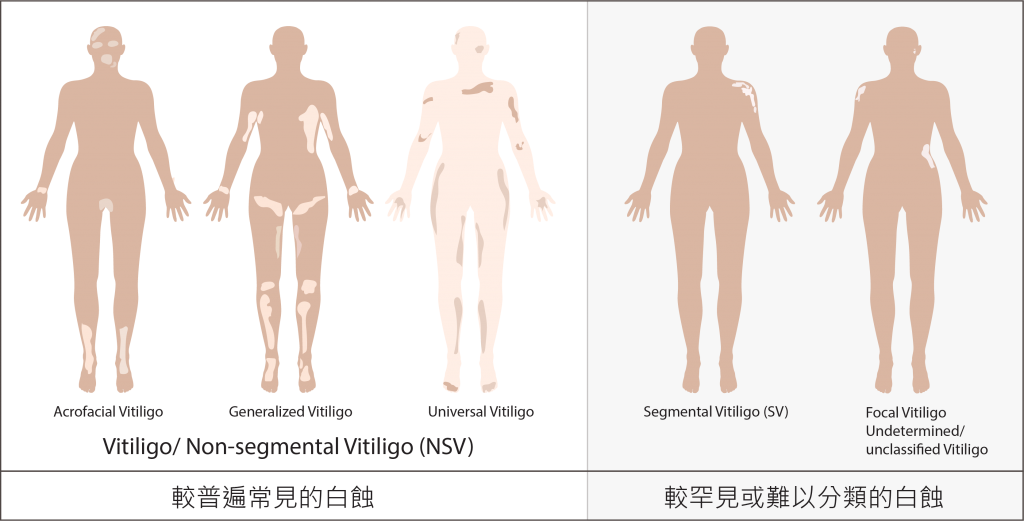
- There are two main forms: non-segmental (about 85% of cases, symmetrical, may progress unpredictably) and segmental (one-sided, early onset, stabilises quickly, responds well to surgery).
- Effective treatment exists. The three goals are to stop it spreading, restore pigment, and prevent relapse.
- A topical JAK-inhibitor cream is now registered in Hong Kong for non-segmental vitiligo involving the face, alongside established options such as narrowband UVB, 308 nm excimer, topical calcineurin inhibitors and grafting.
- Repigmentation is slow. Expect a minimum of 3–6 months before judging any treatment, and 12–24 months for a full result.
What is vitiligo?
Vitiligo is an acquired condition in which melanocytes — the cells that make pigment — are progressively destroyed by the body's own immune system. Where those cells are lost, the affected area turns chalky or milky white.
The mechanism is now well understood. Melanocytes under stress release signals that attract cytotoxic T-cells. Those T-cells produce interferon-gamma, which drives a chemokine loop (CXCL9 and CXCL10) that recruits still more T-cells to the area. Interferon-γ–driven immune pathways and downstream JAK-STAT signalling have been implicated in melanocyte destruction in vitiligo, and this mechanistic understanding has driven interest in JAK inhibitors as potential disease-modifying agents. This is why the newer treatments work, and why they represent a real change from the era of steroids and sunlight.
Importantly, a reservoir of immature melanocytes survives in the hair follicle. Repigmentation happens when those cells are coaxed out of the follicle, multiply, and migrate outwards — which is why returning colour often appears first as small dots around hair openings, and why areas with few follicles (fingertips, lips) are the hardest to treat.
What vitiligo is not: it is not infectious, not caused by diet, not caused by "toxins" or bad hygiene, and not a form of cancer. It is not caused by anything you did.
How common is vitiligo?
Vitiligo affects over 65 million people worldwide. Men and women are affected equally, although women and parents of affected children tend to seek assessment earlier.
|
Population |
Reported prevalence |
|
Worldwide |
0.5% – 2% |
|
Chinese population surveys |
approximately 0.5% |
|
Hong Kong (estimated) |
approximately 35,000 – 40,000 people |
|
Onset before age 20 |
about half of all cases |
|
Onset before age 10 |
about one quarter of cases |
There is no robust Hong Kong prevalence study; the local figure above is an extrapolation from Chinese population data and should be read as an estimate. What is clear is that in Fitzpatrick type III–IV skin — the majority in Hong Kong — the contrast between affected and unaffected areas is far more visible than in fair-skinned populations. The measured impact on quality of life is correspondingly higher, and this is a legitimate medical reason to treat, not a cosmetic afterthought.
Reference:
- Ezzedine K, et al. Revised classification/nomenclature of vitiligo. Pigment Cell Melanoma Res. 2012 — VGICC consensus, basis of the classification section.
- Eleftheriadou V, et al. British Association of Dermatologists guidelines for the management of people with vitiligo. Br J Dermatol. 2022.
- Seneschal J, Taïeb A, et al. European Dermatology Forum / EADV vitiligo guideline (most recent update).
- Rosmarin D, et al. Two Phase 3, Randomized, Controlled Trials of Ruxolitinib Cream for Vitiligo. N Engl J Med. 2022 — TRuE-V1 and TRuE-V2.
- Passeron T, Prajapati V, Sivamani R, et al. Efficacy and safety of upadacitinib in adolescents and adults for treatment of non-segmental vitiligo: results of two phase 3 studies (Viti-Up). Presented at the 2026 American Academy of Dermatology Annual Meeting, March 27–31, 2026, Denver, CO.
- China Medical System Holdings. New Drug Application of ruxolitinib phosphate cream for vitiligo approved by the Pharmacy & Poisons Board of Hong Kong, 4 November 2024.
- Cavalié M, et al. Maintenance therapy of adult vitiligo with 0.1% tacrolimus ointment: a randomized, double-blind, placebo-controlled study. J Invest Dermatol. 2015.
- Bae JM, et al. Phototherapy for vitiligo: a systematic review and meta-analysis. JAMA Dermatol. 2017.
- Middelkamp-Hup MA, et al. Treatment of vitiligo vulgaris with narrow-band UVB and oral Polypodium leucotomos extract: a randomized double-blind placebo-controlled study. J Eur Acad Dermatol Venereol. 2007.
- Hong Kong Drug Office, Department of Health — search the local registration status of any medicine mentioned.