
Prognosis: what to realistically expect
Vitiligo is unpredictable, but prognosis follows recognisable patterns.
Response by body site — the most useful predictor:
| Site | Expected response |
| Face, neck, forehead | Best — often excellent |
| Trunk | Good |
| Arms and legs | Moderate |
| Hands, feet, fingers, toes | Poor — few hair follicles |
| Lips | Poor |
| Over bony prominences | Poor |
Favourable features: recent onset; younger age; facial, neck or trunk involvement; no white hairs within patches; currently stable; darker constitutional pigmentation.
Less favourable features: long duration; involvement of hands, feet or lips; white hairs within patches; active Koebner phenomenon; very extensive disease.。
Realistic expectations, honestly stated:
- Spontaneous repigmentation without treatment occurs in fewer than 10–20% of patients and is usually partial.
- No treatment works quickly. Three to six months is the minimum before any judgement can be made.
- Repigmentation typically appears first as small dots around hair openings within the patch, gradually merging.
- Returning pigment may initially be darker or lighter than surrounding areas; this usually evens out over months.
- The realistic goal for most patients is substantial improvement in visible areas, not complete clearance of every patch.
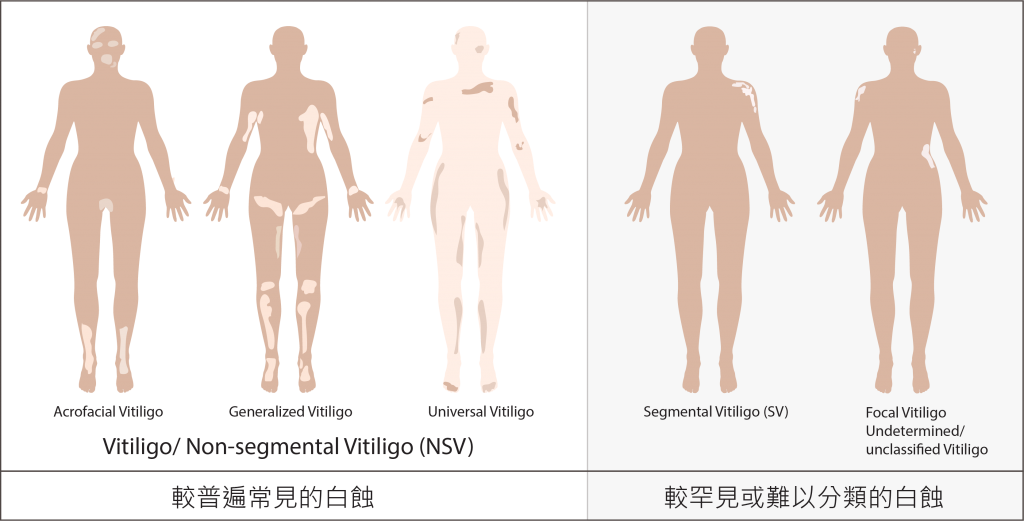
- Segmental vitiligo stops spreading on its own within 6–24 months and rarely recurs, but medical treatment seldom repigments it — surgery is the answer.
- Vitiligo remains a lifelong tendency. Maintenance treatment is what keeps results.
Reference:
- Ezzedine K, et al. Revised classification/nomenclature of vitiligo. Pigment Cell Melanoma Res. 2012 — VGICC consensus, basis of the classification section.
- Eleftheriadou V, et al. British Association of Dermatologists guidelines for the management of people with vitiligo. Br J Dermatol. 2022.
- Seneschal J, Taïeb A, et al. European Dermatology Forum / EADV vitiligo guideline (most recent update).
- Rosmarin D, et al. Two Phase 3, Randomized, Controlled Trials of Ruxolitinib Cream for Vitiligo. N Engl J Med. 2022 — TRuE-V1 and TRuE-V2.
- Passeron T, Prajapati V, Sivamani R, et al. Efficacy and safety of upadacitinib in adolescents and adults for treatment of non-segmental vitiligo: results of two phase 3 studies (Viti-Up). Presented at the 2026 American Academy of Dermatology Annual Meeting, March 27–31, 2026, Denver, CO.
- China Medical System Holdings. New Drug Application of ruxolitinib phosphate cream for vitiligo approved by the Pharmacy & Poisons Board of Hong Kong, 4 November 2024.
- Cavalié M, et al. Maintenance therapy of adult vitiligo with 0.1% tacrolimus ointment: a randomized, double-blind, placebo-controlled study. J Invest Dermatol. 2015.
- Bae JM, et al. Phototherapy for vitiligo: a systematic review and meta-analysis. JAMA Dermatol. 2017.
- Middelkamp-Hup MA, et al. Treatment of vitiligo vulgaris with narrow-band UVB and oral Polypodium leucotomos extract: a randomized double-blind placebo-controlled study. J Eur Acad Dermatol Venereol. 2007.
- Hong Kong Drug Office, Department of Health — search the local registration status of any medicine mentioned.