
What causes vitiligo?

Vitiligo is multifactorial. No single cause explains it.
Genetic susceptibility. Around 20% of patients have an affected relative. More than 50 susceptibility loci have been identified, most involving immune regulation. Inheritance is not straightforward — having a parent with vitiligo raises risk but does not make it inevitable.
Autoimmunity. The dominant mechanism, as described above.
Oxidative stress. Melanocytes in vitiligo handle oxidative stress poorly, which may be the trigger that exposes them to immune attack.
Trigger events. Physical trauma, sunburn, friction, chemical exposure (phenols in some hair dyes, adhesives, industrial rubber), severe illness or major psychological stress can precede onset.
Koebner phenomenon. New patches appearing at sites of injury — a scratch, a burn, a surgical scar, or persistent friction from a belt or bra strap. Its presence indicates the disease is currently active.
Types of vitiligo
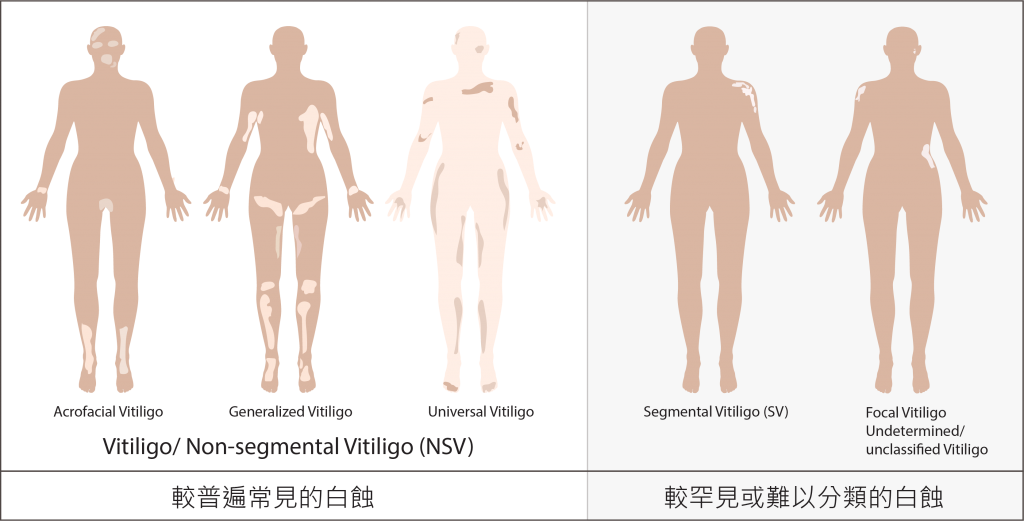
Classification matters because it determines treatment and prognosis. The framework below follows the Vitiligo Global Issues Consensus Conference.
Type
Features
Typical course
類型
Non-segmental (NSV)
特徵
病程
About 85% of cases. Symmetrical, both sides of the body. Favours the face, hands, elbows, knees, feet, genital area.
Unpredictable. May be stable for years then flare. Best response to medical treatment.
Acrofacial
特徵
病程
Around the eyes and mouth, fingers, toes
Facial areas respond well; fingers and toes are stubborn
Generalised (vulgaris)
特徵
病程
Widespread scattered patches
The commonest presentation
Universal
特徵
病程
More than 80% of the body surface
Rare; depigmentation may be considered
Mucosal
特徵
病程
Lips and genital mucosa
Often resistant
類型
Segmental (SV)
特徵
病程
5–16% of cases. One-sided, does not cross the midline, follows a band-like distribution. Younger onset. White hairs appear early.
Spreads for 6–24 months, then stops permanently. Poor response to medical treatment, excellent response to surgery.
Mixed
特徵
病程
Segmental plus non-segmental in the same person
Treated as non-segmental
類型
Focal / undetermined
特徵
病程
A small isolated patch not fitting either pattern after 1–2 years
May remain static or evolve
Non-segmental vitiligo, the most common form, is marked by symmetrical and bilateral depigmented white patches and is prone to unpredictable progression even after long periods of stability.
The second axis is activity: is it currently spreading or not? This changes management more than anything else. Signs of active disease include confetti-like tiny white dots, trichrome lesions (a shaded intermediate zone at the edge), poorly defined or inflamed borders, and new patches at sites of injury. Active disease needs stabilising first. Stable disease can proceed directly to repigmentation or grafting.
Reference:
- Ezzedine K, et al. Revised classification/nomenclature of vitiligo. Pigment Cell Melanoma Res. 2012 — VGICC consensus, basis of the classification section.
- Eleftheriadou V, et al. British Association of Dermatologists guidelines for the management of people with vitiligo. Br J Dermatol. 2022.
- Seneschal J, Taïeb A, et al. European Dermatology Forum / EADV vitiligo guideline (most recent update).
- Rosmarin D, et al. Two Phase 3, Randomized, Controlled Trials of Ruxolitinib Cream for Vitiligo. N Engl J Med. 2022 — TRuE-V1 and TRuE-V2.
- Passeron T, Prajapati V, Sivamani R, et al. Efficacy and safety of upadacitinib in adolescents and adults for treatment of non-segmental vitiligo: results of two phase 3 studies (Viti-Up). Presented at the 2026 American Academy of Dermatology Annual Meeting, March 27–31, 2026, Denver, CO.
- China Medical System Holdings. New Drug Application of ruxolitinib phosphate cream for vitiligo approved by the Pharmacy & Poisons Board of Hong Kong, 4 November 2024.
- Cavalié M, et al. Maintenance therapy of adult vitiligo with 0.1% tacrolimus ointment: a randomized, double-blind, placebo-controlled study. J Invest Dermatol. 2015.
- Bae JM, et al. Phototherapy for vitiligo: a systematic review and meta-analysis. JAMA Dermatol. 2017.
- Middelkamp-Hup MA, et al. Treatment of vitiligo vulgaris with narrow-band UVB and oral Polypodium leucotomos extract: a randomized double-blind placebo-controlled study. J Eur Acad Dermatol Venereol. 2007.
- Hong Kong Drug Office, Department of Health — search the local registration status of any medicine mentioned.