
Education
Phototherapy Practice: Narrowband UVB (NB-UVB) and Excimer Laser
When the lesion area of vitiligo is large (e.g., exceeding 5% of total body surface area) or when topical medications yield unsatisfactory results, Phototherapy becomes a core pillar of clinical treatment2. The biological effects of phototherapy are twofold: on one hand, it induces apoptosis of T lymphocytes within localized lesions, reducing autoimmune attack; on the other hand, it directly stimulates dormant melanocyte stem cells in the outer root sheath of hair follicles to proliferate, differentiate, and migrate toward the epidermis.1。
窄譜中波紫外線(Narrowband UVB, NB-UVB) is currently the standard phototherapy regimen recommended by international guidelines2. Compared to earlier photochemotherapy (PUVA), NB-UVB utilizes ultraviolet light with wavelengths concentrated at 311–312 nm and does not require oral photosensitizing drugs (Psoralen), significantly lowering the risk of nausea, phototoxic burns, and long-term carcinogenicity2. Patients usually undergo full-body or targeted irradiation 1 to 2 times per week. The initial dose is determined according to the patient's Fitzpatrick skin type and is subsequently fine-tuned based on the erythematous response7.
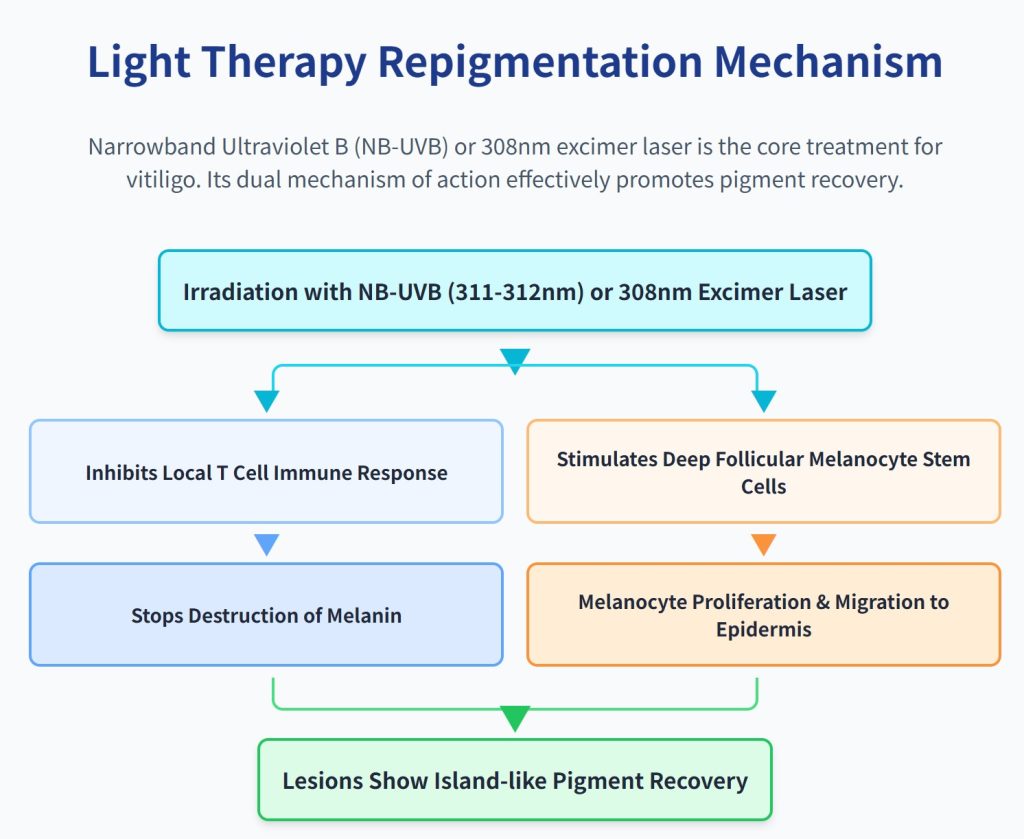
For small-area, localized, or refractory areas (such as joints of the hands and feet) affected by vitiligo, the 308nm Excimer Laser/Light provides a more precise solution1. The excimer laser delivers monochromatic light with high energy density, directly targeting the affected area while completely avoiding the surrounding normal skin, thereby accumulating a higher therapeutic dose and shortening the time required to achieve repigmentation1.
Phototherapy typically requires a relatively long course of treatment. Patients often begin to observe island-like pigment spots (islands of repigmentation) around hair follicles after receiving 20 to 30 sessions of irradiation, whereas achieving satisfactory pigment recovery usually requires continuous treatment for more than 6 to 12 months7. The most common side effects of phototherapy include mild erythema, dry skin, and itching at the irradiation site, which can usually be smoothly alleviated by adjusting the radiation dose and applying moisturizers.7.
Reference
-
British Association of Dermatologists guidelines for the management of people with vitiligo 2021 | Request PDF - ResearchGate, https://www.researchgate.net/publication/352686774_British_Association_of_Dermatologists_guidelines_for_the_management_of_people_with_vitiligo_2021
-
Vitiligo - Primary Care Dermatology Society, https://www.pcds.org.uk/clinical-guidance/vitiligo
-
British Association of Dermatologists guidelines for the management of people with vitiligo 2021*, https://bpg.org.uk/wp-content/uploads/2024/01/Br-J-Dermatol-2021-Eleftheriadou-British-Association-of-Dermatologists-guidelines-for-the-management-of-people-with-vitiligo.pdf
-
China Medical System: New Drug Application of Ruxolitinib Phosphate Cream for Vitiligo Approved in Hong Kong – CMS, https://web.cms.net.cn/en/2024/11/china-medical-system-new-drug-application-of-ruxolitinib-phosphate-cream-for-vitiligo-approved-in-hong-kong/
-
Vitiligo: Unmet Need, Management and Treatment Guidelines - PMC, https://pmc.ncbi.nlm.nih.gov/articles/PMC10824320/
-
Treatment for Nonsegmental Vitiligo | OPZELURA® (ruxolitinib), https://www.opzelura.com/vitiligo/
-
Vitiligo: Diagnosis and treatment - American Academy of Dermatology, https://www.aad.org/public/diseases/a-z/vitiligo-treatment
-
Professional Vitiligo Treatment in London | The Thomas Clinic, https://thomasclinic.com/conditions-treatments/vitiligo-treatment/